It was a couple of years ago that Chris passed me his manuscript for From Destinations Set. He seemed quite bewildered by it, and said he wasn’t sure if it was publishable on account of the formatting. Then, last year, he announced his departure from Clinicality Press because the burden of running a publishing company on top of writing and reviewing was proving unmanageable. So I asked if he would mind me putting Destinations out as a sort of ‘thank you’ for the work he put in establishing Clinicality Press – if I could figure out the file conversion. He agreed.
Initially, having sorted out the formatting, I opted for a super-sleek and ultra-cool (in a retro sort of a way) hardback. Production proved expensive, and the necessarily high retail price was destined to be an obstacle to sales, so a download version followed.
Now, at long last, the first batch of trade paperbacks are in, sitting in boxes in the Clinicality office. Review copies and press releases are going out, and so I decided it was worth celebrating the event by shouting Chris a pint or three. I thought I’d also grill him about the book while I was at it.
The following ‘interview’ was conducted / constructed in similar fashion to The Job, the book of interviews with William Burroughs and Daniel Odier, in which some questions were answered face to face, before Burroughs subsequently provided large segments of text he had already written (and sometimes published) elsewhere to expand on some responses, and to provide more detailed replies.
SB: I read the piece you wrote about Destinations when the hardback came out, and you said that the book ‘was a bitch to write.’ How was it so?
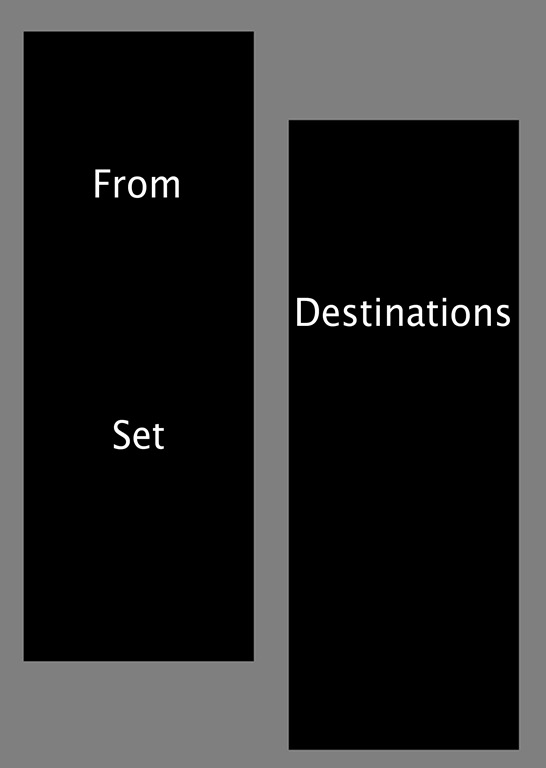
CN: In every way. I mean, I came up with the concept of two simultaneous narratives – something I’d done in short sections before, notably in ‘A Call for Submission’. I first same up with the idea back in, what, ’99, when I wrote the short story ‘His ‘n’ Hers,’ and there are sections in my unpublished novels Exiled in Domestic Life and Rusty Bullet Wounds. But I wanted to take it further. I was going for the Semina series – they were holding open submissions for a couple of years – and having been shortlisted the first time, I wanted to do something really radical. They wanted experimental, innovative, and I thought that a dual narrative would really fit the bill. The concept and the interlooping, interrelated stories and narrative tracks evolved from there. But I really had to immerse myself in the process. I tend to set myself targets and rules when I’m writing something big, usually timescales and the like. But also there are elements of research and the question of getting myself into a certain frame of mind. As most of my writing’s pretty warped in one way or another, producing something like Destinations required, to a degree, stepping into the book, immersing myself in it. Producing a text that’s so wilfully disorientating was extremely disorientating. And that was before I had the small matter of the formatting to contend with.
SB: So what was it about the formatting?
CN: Everything! Essentially, while I have a reasonable working knowledge of Office, I’m still using Word 97 – partly because subsequent versions haven’t actually been as good and partly because I can’t afford to upgrade – I’m not super-knowledgeable about all aspects of the program, and so when I started writing I simply set up my document as two automatically set columns and started typing… the trouble was that any edit made in one column affected the other, and any changes made on one page would see the whole text shunt into the wrong column by a few lines and just completely screw the whole document. The writing process was tough enough, but making edits and corrections… and of course, I created the text as an A4 document without any consideration for how it may be converted to something the size of a book. You can’t just change the page layout and boom! book sized document. So I had all that to contend with while trying to create the most complex of plots and ensure that the two simultaneous narratives met in the places I wanted them to. The passages where the two narratives mirror one another or otherwise play of one another were rendered all the more difficult by the technical aspects, and amplified by my limited capabilities. You could say that ambition extended beyond technical skill. I like a challenge, of course, but this was perhaps beyond what could be considered sensible. And then there was the time factor….
SB: What was the issue there?
CN: Well, as I said, the book started out for submission to BookWorks, who were doing the Semina series. Stewart Home was the commissioning editor, and I submitted a proposal for the 2007 round of open submissions and got shortlisted before finally being rejected, largely on account of the fact my postmodern reworking of Hamlet, retold using song lyrics and the like within the body of the text, wasn’t quite experimental enough. So I decided to try again the next year and the submission required a synopsis and the first 20 pages, which I managed to knock out without too much difficulty, formatting notwithstanding. I was pretty pleased with what I’d done, but hadn’t really considered the problems producing the full manuscript might create, the fact that the longer the text became, the greater the issues of editing earlier pages later on in the process would be. Anyway, I fired off the submission and forgot about it for a few months. I’d not long done THE PLAGIARIST and was getting on with other things.
It made the 2008 shortlist in the Spring of that year. If commissioned, the time for getting the thing finished and to the publisher would be pretty tight. Realising that to produce anything like a complete working manuscript would take a lot of time and effort, I pushed on with putting some meat on the bones of the remainder. In the end it wasn’t commissioned (I can’t really grumble: the books that did come out are brilliant), but I was committed to seeing the project to completion. So I did. It almost drove me round the bend, and when I was done I had a manuscript that was probably my best to date, and nothing to do with it.
I tried a few publishers, largely without any kind of reaction whatsoever. One or two asked to take a look at it before deciding it wasn’t their thing or they didn’t have a clue what to do with a book like mine. It was hardly a surprise. It’s a pretty radical and challenging text, and the appearance and presentation is going to be an obstacle to many readers. Publishers are hardly going to be queuing up to get it on their roster.
SB: I’d say it’s probably the most radical book to be published anywhere since Mark Z. Daneiewski’s House of Leaves.
CN: Yeah, in many ways it probably is. With THE PLAGIARIST I had a whale of a time, letting the experimentation lead the ‘writing’, but despite pitching it as being the most out there book ever, ever, really it was just a cut-up that followed on from Burroughs and Kenji Siratori. That I’m a complete Burroughs fan is no secret, and my appreciation of Siratori is hardly news either. It was reading BACTERIA=SYNDROME that compelled me to do THE PLAGIARIST, in fact. Siratori was recycling text, and so I thought it would be a wheeze to recycle his formula and knock out a book in three months that not only out-Siratori’d Siratori, but also pithily addressed notions of influence, which is why the Hamlet stuff is in there. Amazingly, Stewart Home’s Blood Rites of the Bourgeoisie makes similar use of spam emails, which were the other primary source of material for the book. So with THE PLAGIARIST, I was trying to be ultra-derivative while feigning originality, whereas with Destinations I wanted to really dig into narrative proactive and the construct of character.
Danielweski’s works are certainly in the same sphere, in that they’re concerned with problemetising the act of reading. They’re very visual, and also demand a high level of engagement and interaction from the reader. That’s precisely what Destinations is all about.
On the other hand, it’s nothing that hasn’t been done before, and I make no pretence concerning vague notions of pure originality. I’m thinking of John Giorno’s poems that are presented in two-columns, such as ‘Johnny Guitar’ and ‘Cum.’ His works of the late 60s and early 70s were remarkably innovative, and although the collected poems Subduing Demons in America has come out quite recently, I still don’t think he receives nearly the acknowledgement he deserves. He’s an astounding writer. Then there’s also the idea of the split screen. It’s been done in film for decades. I really like the way the two-column narrative replicates that in text. In film, people are fine with it, it’s not seen as being problematic and it’s understood what the function of the split screen is. It’s become a convention. Why not in literature? So I really wanted to take that to its logical conclusion in Destinations.
SB: With all of this in mind, what kind of headspace did you find yourself in during the writing process?
CN: A very intense one! I do tend to write with a great degree of focus, and immerse myself in the work quite deeply. It means that breaking out of the writing to tend to everyday tasks can become quite difficult. Interacting with other people, that sort of thing, can get quite strained. It feels almost alien. Life doesn’t take on a dream-like quality as such, but is very like being extremely tired or badly hungover: one finds oneself disconnected and unable to really get into step with the world around. That was quite appropriate for Destinations: it was that kind of sensory detachment that I wanted to write about and for my characters to experience. I hope that through the characters, the reader will feel a similar sense of separation, of disorientation, of being out of step and not entirely in control or ‘there’. But it was odd to think that in trying to write an experience, I was bringing it into my own life. It was as if I was writing my own script – which, of course, also happens to be a key aspect of the plot or plots and the way they interrelate.
SB: So would this be an example of the ‘method writing’ you’ve mentioned previously?
CN: Sort of, yes. It’s not really method writing in the sense that a method actor lives the life of the role or whatever, but I use the term because it seems to fit reasonably well to my experiences while writing. That is, although I don’t set out to put myself in my characters’ shoes and I certainly don’t live out or act out the book in whole or in part, I do often find myself sharing the mindset of my characters or otherwise stepping into the states I’m describing. If I’m writing a character who’s permanently drunk, I won’t spend a month off my face, but I do find I’m likely to drink more while I’m working. I’ll also dredge deep and relive experiences from my past in order to feel certain kinds of emotions again. It’s much easier to describe the power of those emotions while their echoes are coursing through your system. I suppose in that sense, I write as a cypher or conduit. I channel those emotions and experiences directly into the text.
SB: In that you put so much into the writing, would it be fair to say that there’s a lot of ‘you’ in the text? How much are the characters autobiographical?
CN: Not at all. There’s a lot of ‘me’ in the text inasmuch as ‘I’ wrote it, the characters are ‘my’ creations, but I’m none of the characters in any of my books, not even the unpublished ‘autobiographical’ novels, Exiled in Domestic Life and Rusty Bullet Wounds. In those, the narrator and central character has my name, and elements of the plot and the other characters are based on my experiences and people I’ve known, but they’re autobiographical in the way that Burroughs, Bukowski and Miller wrote autobiographically.
Generally speaking, I’m not interested in characterisation, or even that concerned with plot in the conventional sense. By and large, my characters are all vehicles for something. In Destinations, I specifically set out with the purpose of exposing and exploring the artifice of character. In that sense, I’m drawing out a comment Stewart Home made in an interview in 1994 about his book Pure mania when he said ‘I’m not interested in traditional notions of literary depth, and characterisation bores me’. While Destinations is more character-orientated than my previous works, it’s very much about character as construct rather than my development of multi-faceted characters in the conventional literary sense.
People sit around pontificating about the books they’ve read and talking about the great characters in this or that book, how they’re multi-faceted and multi-dimensional, how they have depth and are credible or believable or engaging or whatever. Fine, but so many readers get incredibly hung up on character and engage with characters to what I’d consider an unhealthy extent. Credible characterisation and dialogue is all well and good, but people really care too much for these creations – it’s like with TV soaps when viewers talk about the characters as though they were real.
With Destinations, I wanted to really highlight the idea of the character as a construct. But not just fictional characters. The people you know in real life are characters too. They’re playing parts, roles they’ve been cast in your life, you compartmentalise your friends and family, perceive them in a certain way. In doing so, you actively determining their character. Who you are determines to a lesser or greater extent how they behave around you. You’re shaping their character, in the present. And that’s precisely how the characters in Destinations evolve. They shift from one scene to the next as they’re rewritten, edited, re-imagined, reconsidered.
At the risk of sounding self-contradictory, the fact that the characters dissolve and reform, mutate and deform, and change from scene to scene is closer to the actuality of how real-life characters exist. Character isn’t fixed. But because I’ve framed the characters of Anthony and Tim – especially Tim – within the book, they’re very malleable characters who are constructed, deconstructed and reconstructed before the reader’s eyes.
SB: The title suggests that you’re also exploring notions of predeterminism…?
CN: Yes. And no. I’m painfully aware that everything I say about the book and my writing and even myself seems wholly contradictory. But that’s essentially the point, I suppose. The concept that character isn’t fixed, that plot isn’t fixed… Consider it this way: I do believe that you make your own luck. For example, if you want a job, you’re not going to land it if you don’t apply for it. As a writer, you’re never going to make it if you don’t get yourself or your writing out there. No-one’s going to come knocking on your door or ringing your phone saying ‘Hey, I hear you’ve got a great novel-in-progress in a pile of notepads stashed under your bed’ or ‘Hey, I reckon you’ve got great management skills: can I see your CV?’ You need to be seen by the right people. That entails being seen by people full stop, because they can’t all be right.
But I do believe that working hard won’t equal success. You can do all the ‘right’ things, have all the ‘right’ contacts, whatever, and still end up with fuck all to show. Meanwhile, some jammy cunt appears from nowhere with no credentials and has everything land in his lap without doing a thing to warrant it. How does that happen? You see, making your own luck only counts for so much. Talent or ability or whatever only count for so much. The system can work against you. All the luck-making in the world counts for nothing if your face doesn’t fit or your timing’s not right, or whatever. Then you say ‘maybe it’s not your time, your day… your life.’
So I can see both sides. And I speak from experience.
In Destinations, I’m questioning the ideas of ‘success’. The two characters have very different, conflicting ideas regarding what constitutes success. Tim’s all about the materialistic trappings of success. But he’s not happy. In fact, he’s desperately unhappy, but the trouble is, he doesn’t even know his own mind. Anthony’s anti-materialistic and has a completely different idea of success… but is he happy? No, he’s as much as a fuck-up as Tim.
SB: Do you think you run the risk of being seen as wilfully difficult, as an author and as an individual?
CN: I know I do, in everything I do. I am wilfully difficult. No, look, here’s the deal: I run the risk of being perceived as ‘difficult’ because I don’t tolerate fools and I refuse to dumb down. It’s not for me to dumb down: it’s for the broader population to wise up. If that’s perceived as difficult or serves to be somehow alienation or an obstacle to my success, then so be it. I’d rather be a failure on my own terms than a success on the terms of the masses. And yes, I appreciate that this may appear to be self-defeating, like I’m shooting myself in the foot. But as you’ll have realised by now, I’m not in it for the money, or the glory. It’s all about the ART, man!
Having said that, I think there is definitely an appetite for challenging works. Inception was extremely complex for a Hollywood blockbuster, and I think – apart from being visually stimulating and having big names in it – a lot of its success was down to the fact people are fed up of being spoon-fed predigested slop by the media. The same is true of films like Shutter Island and Fight Club. Palahniuk’s book is great, but being great doesn’t usually equal immense success. The fact that there are great books that are challenging in various ways that do achieve the success and recognition they deserve gives me hope that there is a market for me.
SB: So why have you stuck with Clinicality rather than pushing for bigger publishers?
CN: Having been fifty per cent responsible for starting Clinicality, I have a very strong connection to it. I can see it growing. But more than that, the publishing industry and book retail are changing fast. They’re having to, and not just because of the Internet – although publishers and retailers going to the wall invariably cite the Internet as the reason for their demise. They can’t compete, apparently. I can see their point, and I miss book shops as much as the next avid reader, but by and large, good book stores still do ok. People like books, people do still read, and it’s not all about the Kindle. But many publishers and retailers are failing because they’re all chasing the same corner of the market – the populist mass market. Of course they are, it’s all about the numbers. The mainstream middle ground has the greatest potential for high volume sales, it’s all about the high profile bestsellers. But because it’s so competitive, there’s the constant need to discount and drive prices down in order to increase volumes. Margins are consequently tighter. What they’re ignoring is that there are countless niche markets, some of which are huge. Ok, so the horror, fantasy and crime fiction niches are now well tapped and bordering on saturation, but…
As some observers have noted, the development of the underground press in the 1950s that grew as a response to the social indifference and journalistic vacuum at the end of the silent generation of the 1950s. I think there are distinct parallels between the late 1950s and early 1960s and now. Moreover, periods of social unrest – such as the sixties, and the eighties, when unemployment was high and everyone was living under the threat of nuclear war – tend to be fertile periods in artistic terms. The sixties and the eighties both saw underground presses flourishing: the seizing of one’s means of literary production is all about freedom and taking the power back.
Right now, technology has indubitably changed people’s buying habits, people’s reading habits, and it’s also facilitated a shift away from the big publishers. They no longer hold the monopoly they once did, and still present themselves as having. Time was when you did need an agent and a major publisher, and sure, if the mainstream audience is your target audience you still do. But now it’s possible to reach audiences directly and retain complete creative control. That kind of freedom is liberating, and is great in creative terms because it’s not market driven. Sure, the audiences may be smaller, but they’re less likely to be fickle or to be swayed by trends, and therefore there’s a degree of dedication and loyalty not so readily present in the mainstream.
Plus I got sick of the rejection. Touting a work round countless agents, editors and publishers and having to wait indefinitely to be ignored and / or ultimately rejected is time-consuming and arduous, not to mention downright depressing at times. Time is precious and time spent waiting and approaching all of these people is time that could be spent on writing, or directly promoting a work.
SB: You’re very much into the promotion aspect of things, aren’t you? Your postcards and flyers crop up in all sorts of places…
CN: Public toilets, on trains, in shops… yeah, I get around. And why not? I’m only ‘into’ the promotional side of things through necessity, if I’m completely honest, but I do enjoy coming up with different ideas, different approaches, different materials and different locations. I’m not big on the usual kind of methods: I’m getting into showing up at open mic nights, because it’s an unsuspecting audience. I’m all about the guerrilla tactics. Regular readings, organising book launch events, trying to get into local or internet radio, it just doesn’t appeal. It comes down to the fact that I’m not all that comfortable with those types of situation. So I try to approach the (self)promotion from different angles. It works for me, because I’m operating in ways I’m comfortable with, while also doing things that most other writers aren’t. So, you might find band flyers and promo postcards at gigs and in pubs, but not stuff for books.
In some respects, I consider the promotional duties to be projects in themselves.
SB: How do you find the time for it all, if you’re working a regular job, at gigs several nights a week and producing prodigious volumes of music reviews as well?
CN: I’m a pretty committed worker, and I can type reasonably quickly. It also helps that I signed up to a medical experiment a few years ago. Not only have I been genetically modified to have infinite stamina, but I have been successfully cloned. There are currently two of me, and there are more in development. I will achieve global domination, one way or another!
From Destinations Set is out on March 28th through Clinicality Press and can be ordered directly from the publisher now.


 Clinicality Press